


Most of us know the feeling: you wake up in the morning and your bed looks like a battlefield, with the sheet twisted into an uncomfortable bundle. This is exactly the problem solved by a brilliantly simple invention – the fitted sheet with elastic.
Unlike regular sheets, it has a sewn-in elastic band that runs around the entire perimeter or just the corners. This small detail allows the sheet to wrap snugly and smoothly around the mattress, eliminating constant slipping, wrinkling, and fixing. It’s a solution that guarantees not only a tidy bed but also a more restful sleep.
Why a fitted sheet with elastic is an irreplaceable choice
Imagine your sheet as a custom-tailored garment for your mattress. Instead of loose fabric that you constantly have to tuck under the mattress (and which still comes out), the fitted sheet simply “hugs” the corners and stays firmly in place. It’s not just about aesthetics – it’s pure practicality.
Main benefits for your bedroom
The biggest advantage is constant order and comfort. You’ll no longer have to fix a bunched-up sheet in the middle of the night that disturbs your sleep. But that’s not all:
-
Hygiene and protection. A tightly fitted sheet acts as a reliable barrier, protecting your mattress from dust, dirt, or sweat. This is especially important for allergy sufferers, as it helps maintain a cleaner sleeping environment.
-
Time-saving. Making your bed in the morning becomes much faster. The sheet stays in place, so you only need to straighten the duvet.
-
Safety for children. Fitted sheets are a must in children’s beds. They stay firmly in place and don’t create dangerous loose folds that a child could get tangled in.
Essentially, one simple elastic band completely changes the user experience. It’s a small investment not only in a neater-looking bedroom but also in better sleep quality and everyday comfort.
Direct comparison with regular sheets
To make the differences even clearer, let’s look at a direct comparison. It’s immediately obvious why more and more people are choosing the fitted option.
Comparison of fitted sheets and regular sheets
This table will help you visually assess the main features and differences between the two types of sheets.
| Feature | Fitted sheet with elastic | Regular sheet (without elastic) |
|---|---|---|
| Fit | Snugly wraps the mattress and doesn’t move | Hangs loosely, easily wrinkles and slips off |
| Making the bed | Quick and easy, no need to fix | Takes more time, needs to be tucked under the mattress |
| Mattress protection | Effectively protects from dust and dirt | Less protection, as the fabric moves |
| Aesthetics | Always looks neat and smooth | Quickly loses its tidy appearance |
| Use | Ideal for active sleepers and children | Can be uncomfortable for restless sleepers |
As you can see, the fitted sheet with elastic wins in almost every category, especially when it comes to comfort and tidiness. It’s a modern and practical solution for every bedroom.
How to measure your mattress correctly for a perfect fit
We all know the feeling: a poorly sized fitted sheet can become a real headache. Imagine trying to put on a sweater that’s too small – it keeps riding up, stretching, and restricting your movement. The same thing happens with a sheet: if it’s too small, it constantly slips off the mattress corners; if it’s too big, it bunches up into annoying wrinkles.
To avoid all this, take a few minutes for precise measurements. It’s simple, but the most important thing to remember is that length and width alone are not enough. The third dimension – mattress height – is the “secret ingredient” that determines whether the sheet will wrap the corners tightly and stay in place all night.
Three steps to the perfect size
You’ll only need a measuring tape and a few moments. Take these three simple measurements and you can be sure your sheet will fit like a glove.
-
Measure the width. Stretch the measuring tape across the top of the mattress, from one side to the other. Write down the first measurement (for example, 160 cm).
-
Measure the length. Do the same from the head to the foot of the mattress. This will be the second measurement (for example, 200 cm).
-
Measure the height (or depth). This is the key step! Measure the thickness of the mattress from bottom to top. This is the third, crucial measurement (for example, 25 cm). Choose a sheet at least 10 cm higher than your mattress so it can tuck comfortably underneath and won’t slip.
Important nuances when measuring
For the most accurate measurements, pay attention to a few details. They’ll help you avoid mistakes and ensure your new sheet fits perfectly.
First, if you use a mattress topper, be sure to measure the total height – mattress plus topper. A topper can add several to ten centimeters, which drastically changes the required sheet size. If you forget this layer, you risk buying a sheet that simply won’t fit over the corners.
Tip: Look for a sheet with a stated height at least 10cm greater than your mattress (with topper) thickness. For example, if your mattress is 20 cm high, the best choice is a 30 cm high sheet. That extra fabric is needed so the sheet tucks firmly under the mattress and doesn’t slip.
Second, never measure an old sheet. Over time, fabric can shrink or stretch, so the measurements will be inaccurate. Always measure the mattress itself.
With proper measurements, your chosen fitted sheet with elastic will serve perfectly and delight you with order and comfort. And if you want all your bedding elements to match perfectly, you’ll find more tips in our guide on how to choose the right duvet cover size. The right choice is the key to flawless looks and comfort every night.
The best fabrics for your sleeping comfort
Choosing the fabric is probably one of the most important decisions when selecting a fitted sheet with elastic. After all, the fabric is in contact with your skin all night. You could say it’s like a second skin – it must let your body breathe, absorb moisture, and cause no discomfort. That’s why, despite the huge variety of synthetic fabrics, 100% cotton remains an irreplaceable classic.
Natural cotton is exceptionally breathable. Unlike synthetics, which can “trap” heat and cause sweating, cotton allows air to circulate freely. What does this mean for you? In summer, it helps keep you pleasantly cool, and in winter, it retains cozy warmth.
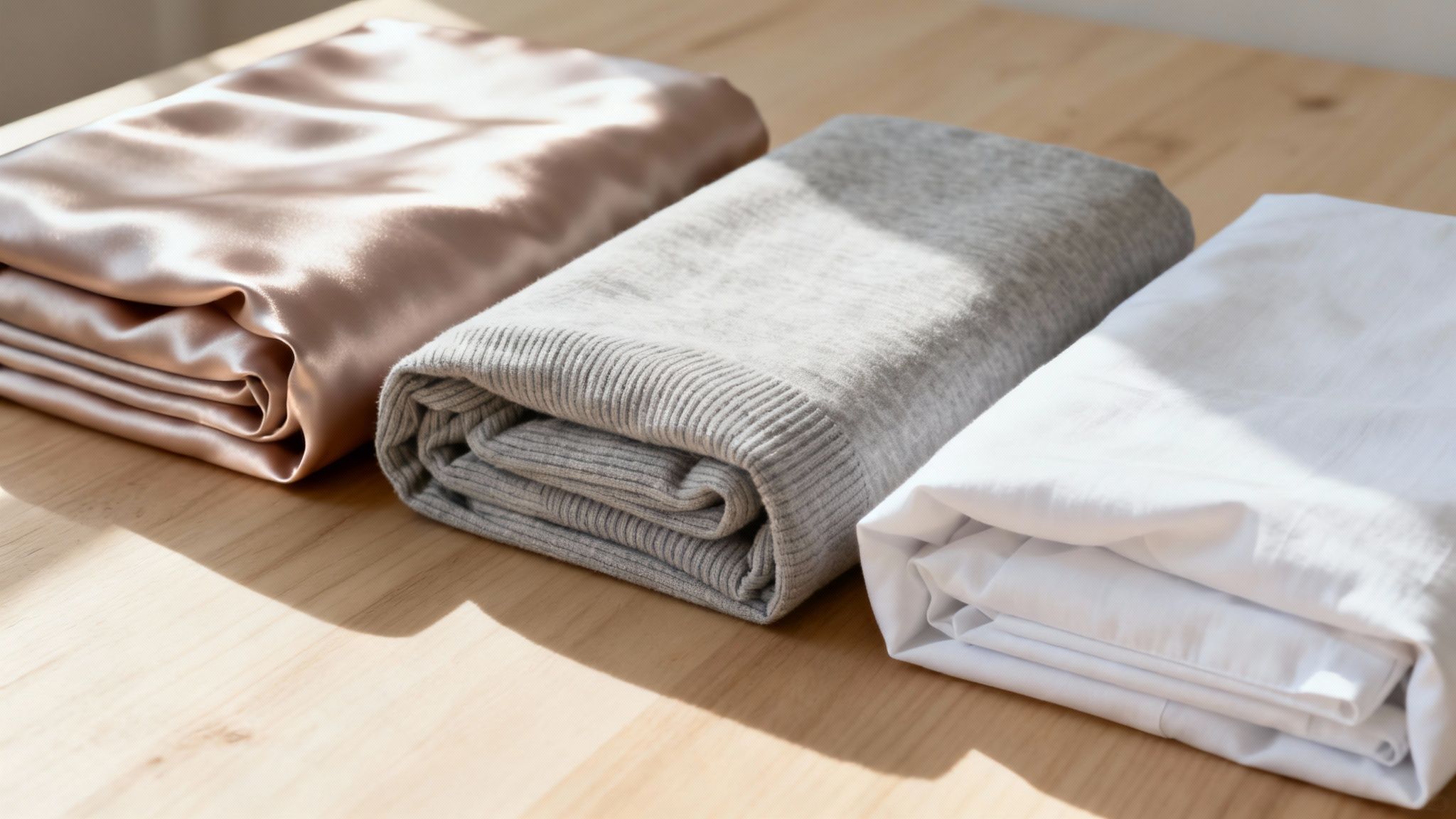
In addition, cotton is hygroscopic – it absorbs moisture very well. Everyone naturally sweats a little at night, and a cotton sheet efficiently wicks this moisture away from your skin, keeping you dry and comfortable until morning. This is especially important for those with sensitive skin or allergies, as natural fibers rarely cause irritation.
The most popular types of cotton for sheets
While all cotton sheets share similar benefits, different weaving methods create completely different feels and properties. Here are the three most popular options worth knowing:
-
Sateen. This is the synonym for luxury and softness. Sateen is woven in a special way, with one thread passing over four others – creating a smooth, slightly shiny, and incredibly soft surface. Sleeping on a sateen fitted sheet is like diving into silky coolness.
-
Jersey. This fabric is knitted, not woven, making it extremely elastic and stretchy. A jersey sheet is soft, cozy, and wraps the mattress perfectly. Thanks to its stretchiness, it’s especially suitable for higher mattresses and is very practical for everyday use.
-
Cotton fabric. This is a classic, durable, and long-lasting fabric. Cotton fabric is tightly woven, so it withstands many washes without losing its shape. Although it may feel a bit stiff at first, with each wash it softens and becomes more pleasant.
The choice between these fabrics depends on your personal priorities. If you value luxurious softness, choose sateen. If you’re after practicality and coziness, jersey is the best choice. And if durability is most important, cotton fabric will never disappoint.
How to recognize quality cotton
Investing in a quality cotton sheet is an investment in your health and good rest. But how do you tell good fabric from bad? Pay attention to the thread count – the higher it is, the denser, softer, and more durable the fabric. A good standard is 200 threads and above.
Also, check the fabric’s finish. Quality cotton will be smooth, with no loose threads or irregularities. It’s also important that the product is certified, for example, OEKO-TEX® STANDARD 100, which guarantees the fabric contains no harmful chemicals.
In Lithuania, the popularity of fitted sheets is constantly growing, and buyers are increasingly choosing high-quality natural fabrics. Market trends show that sateen sheets are among the bestsellers due to their comfort and affordable price. They are most often made from 100% combed cotton, which ensures durability and reliability. To learn more about this fabric’s features, you can read detailed information about the most popular fabric types on our blog.
Over time, you’ll realize that choosing a quality fitted sheet with elastic is one of the best decisions for your bedroom. It not only keeps your bed tidy but also directly contributes to better sleep quality and overall well-being.
Fitted sheets – for peaceful and safe sleep for children
All parents agree – when it comes to children, safety is paramount. Especially during sleep. When making up your little one’s bed, every detail matters, and the fitted sheet with elastic plays a key role here. And it’s not just about comfort – it’s a very important safety issue.
Just think about a simple, loose sheet in a child’s crib. As your child tosses and turns at night, they can easily twist and bunch it into folds. Such loose folds pose a real danger – a baby can get tangled in them or accidentally cover their face, which unfortunately increases the risk of suffocation. The fitted sheet with elastic solves this problem at its core.
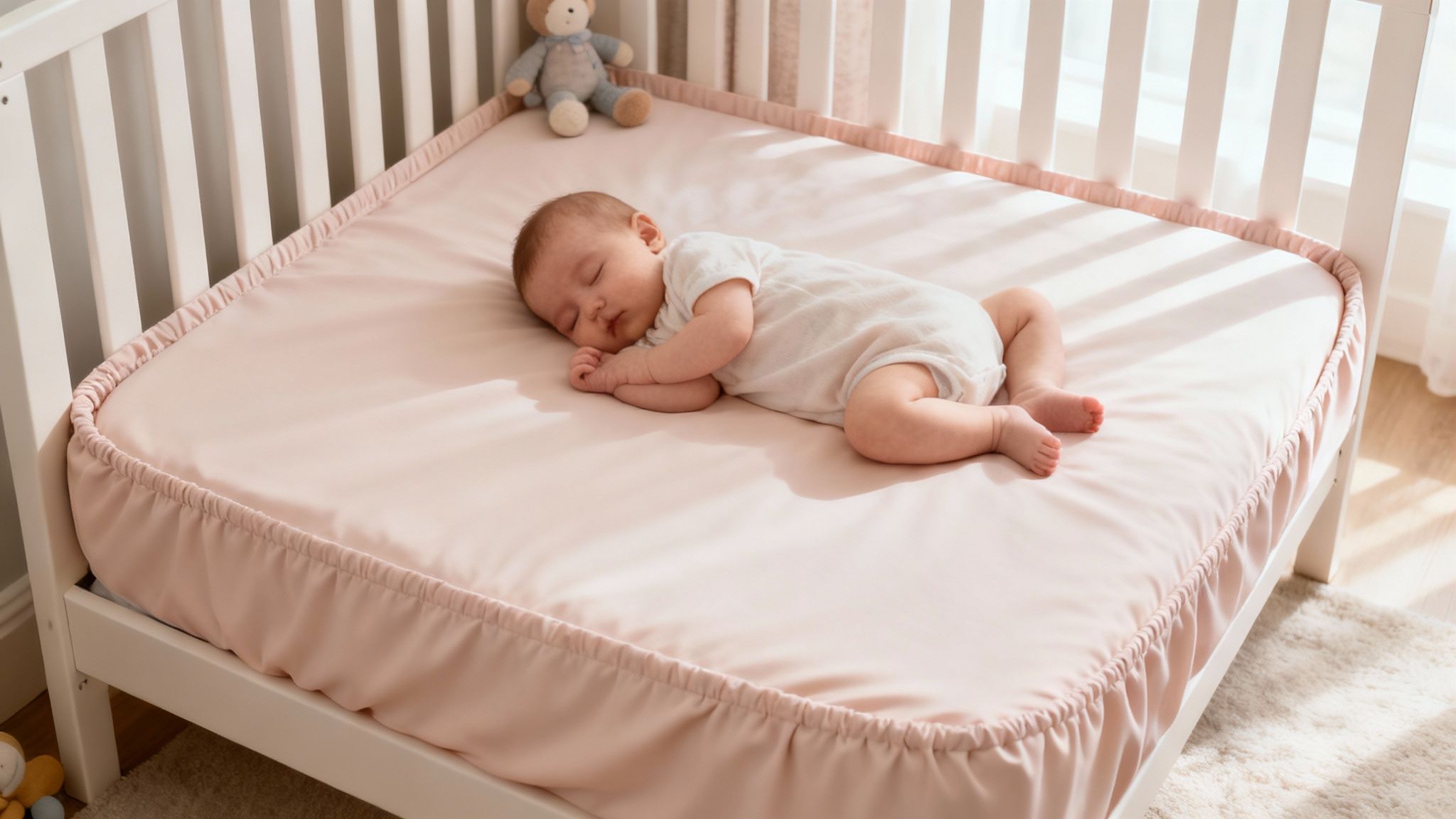
Thanks to the strong elastic, it fits the mattress perfectly and stays smooth all night, no matter how actively your child sleeps. And a smooth, stable surface is simply essential for safe and peaceful sleep for your baby.
Practical help for parents
Beyond obvious safety, fitted sheets are a real lifesaver for parents too. We all know how often children’s bedding needs to be changed – whether due to nighttime “accidents” or just to keep things clean.
Changing a fitted sheet is incomparably easier and faster. There’s no need to struggle tucking fabric edges under a heavy mattress – just slip the corners on, and you’re done. This is especially handy when you need to change bedding quickly in the middle of the night.
Safety and convenience go hand in hand here. By choosing a fitted sheet with elastic, you not only create a safer environment for your child but also make your own daily life much easier.
Custom sewing for non-standard solutions
There’s a wide range of standard bed and mattress sizes, but what if your sleep sanctuary is a little different? Maybe you inherited an old, sentimental bed with unique dimensions, or you have a mattress that’s longer than usual. In such cases, a standard fitted sheet with elastic simply won’t work.
Trying to put on a sheet that’s too small will result in it constantly slipping off the corners. And if the sheet is too big, it will bunch up into uncomfortable wrinkles that not only look bad but also disturb your sleep. That’s when custom sewing becomes not a luxury, but a practical necessity.
When standards no longer fit
When faced with non-standard dimensions, custom sewing opens the door to unlimited possibilities. Skilled seamstresses can create a perfectly fitting sheet that meets all your needs and solves common problems.
The most common challenges solved by custom sewing:
-
Extra-high mattresses. Modern mattresses, especially those with integrated toppers, are often higher than the standard 25 cm. A custom-made sheet will have deep enough corners to wrap the entire mattress securely and reliably.
-
Non-standard length or width beds. Antique, custom-made, or imported beds often have unique dimensions.
-
Beds in campers, yachts, or RVs. In these spaces, beds are often irregularly shaped or have very specific measurements for which there are simply no standard solutions on the market.
Custom sewing guarantees that your investment in a unique mattress won’t be ruined by ill-fitting bedding. It’s a solution that lets you enjoy maximum comfort with no compromises.
Creative freedom and flawless results
One of the biggest advantages of custom sewing is complete creative freedom. You’re no longer limited to standard colors or fabrics. You can choose exactly the shade that perfectly matches your bedroom interior, and the fabric that best meets your expectations – whether it’s luxurious sateen or durable cotton fabric.
Professional seamstresses, like the experienced masters at the “Rustilės” studio, can bring any vision to life. They’ll not only sew the sheet to your measurements but also advise on the best fabric or color for your needs. This personal approach ensures the final product is not only functional but also pleasing to the eye.
If you’re facing the challenge of non-standard dimensions and looking for a reliable solution, consider ordering a custom-made fitted sheet with elastic. It’s an investment in quality, durability, and most importantly, your peaceful and comfortable sleep – no matter how unique your bed is.
How to keep your sheets looking great: long-term care
So, you’ve chosen the perfect, high-quality cotton fitted sheet with elastic. Naturally, you want its softness and rich color to last as long as possible. The good news is that proper care is very simple and feels more like an investment in longevity than a chore.
With the right care, your sheet will not only look like new but also retain its best qualities – letting your skin breathe and absorbing moisture well. Fortunately, cotton doesn’t require special effort, but a few tricks will definitely extend its lifespan.
The art of washing: temperature matters most
The first and most important step is proper washing. While it’s always best to follow the manufacturer’s label recommendations, there are a few universal rules to help protect the fabric.
The optimal washing temperature depends on the type of cotton:
-
For white cotton, higher temperatures like 60°C are usually suitable. This helps effectively remove stains and ensures hygienic cleanliness.
-
For colored fabrics, choose cooler water – up to 40°C. This helps preserve bright colors and protects the fibers from premature wear.
Choose gentle, color-safe detergents without bleach – harsh chemicals can irreversibly damage cotton fibers and fade colors. And one more tip: don’t overload the washing machine. Bedding needs space to move freely and rinse well.
Why skip fabric softener?
Although fabric softener ads promise incredible fluffiness, it can do more harm than good for cotton sheets. Essentially, softeners coat the fibers with a thin, barely noticeable chemical film.
This film gradually reduces cotton’s natural ability to absorb moisture and let air through. As a result, the sheet becomes less “breathable,” which directly affects your sleeping comfort. Instead of softener, try an old trick: add a splash of white vinegar to the rinse compartment. It will naturally soften the fabric and remove detergent residue.
Drying is also important. The best and most fabric-friendly way is to let the sheet air dry outdoors or in a well-ventilated room. If you do use a dryer, choose a low-temperature setting and don’t overdry – heat can damage the elastic’s stretchiness.
The secret to folding fitted sheets
Folding fitted sheets seems like a real challenge to many, but it’s actually much easier than it looks. Just a few steps and it will sit neatly in your closet.
-
Join the corners. Take two adjacent corners and tuck one into the other, as if putting on a cap.
-
Add the others. Do the same with the remaining two corners, then join all four into one neat bundle.
-
Create a rectangle. Lay the sheet on a flat surface – it should now look like a rectangle with rounded edges.
-
Fold as usual. Finally, fold the edges inward to get a tidy rectangle that’s easy to store on a shelf.
A little effort, and the result is worth it – your fitted sheets will stay soft, fresh, and most importantly, comfortable for a long time.
Frequently asked questions
You’ve found the perfect sheet, but before you start enjoying it, a few practical questions always come up. That’s natural. Here are answers to the most common questions about fitted sheets, their care, and use.
One of the biggest worries – will a brand new sheet shrink after the first wash and become too small? No one wants that disappointment. Fortunately, modern technology helps avoid this.
Do cotton fitted sheets shrink after washing?
If the fabric is high quality, such as cotton fabric or sateen, shrinkage will be minimal – just 3–5%. Professional seamstresses always take this into account when sewing, so the final product matches the stated measurements after washing and fits the mattress perfectly. The most important thing is to follow the washing instructions on the label and not exceed the recommended temperature.
Over time, the greatest strain is not on the fabric itself, but on the elastic. So naturally, questions arise about its durability.
Important to remember: Avoid drying the sheet in direct sunlight or on a hot radiator. UV rays and high temperatures are the biggest enemies of elastic – they simply shorten its lifespan.
What to do if the sheet’s elastic stretches out?
If after long and faithful service you notice the elastic no longer grips the mattress tightly, there are solutions. The simplest way is to use your sewing skills and thread in new elastic. Usually, the sheet’s edge has a tunnel for this, so the job is quite easy.
And if sewing isn’t your thing, you can always go to any tailor. Professionals will quickly and affordably renew your favorite sheet. In fact, if you choose a quality product with durable, wide elastic, you’re unlikely to face this problem for many years.
How to choose the best color?
The color of your sheet is not just a detail. It’s an important part of your bedroom’s mood. While it all depends on your taste, there are a few universal guidelines to help you create a harmonious look.
-
Classic white. This is a safe choice that never goes out of style. White gives a sense of freshness, cleanliness, and luxury. Plus, it matches any duvet cover.
-
Neutral tones. Gray, sand, and cream shades create calm and relaxation. They’re practical and easy to pair with both bright and pastel colors.
-
Color matching. Choose a sheet that matches one of the dominant colors in your duvet cover pattern. This creates a cohesive and thoughtful style.
-
Playing with contrasts. If you want a bolder, more dynamic look, don’t be afraid of contrasts. For example, a dark blue sheet looks great with yellow or white covers.
The most important thing is that you like the color you choose and it helps create an environment where you feel calm and cozy. After all, your bedroom is your personal oasis of rest.
Looking for a high-quality, long-lasting sheet that will serve you for years? Visit the Rustilės online store, where you’ll find a wide range of handmade products from 100% cotton and the option to order bedding in custom sizes. Discover the perfect solution for your bedroom at https://rustile.lt.
Leave a comment